
Programs
Vancouver Island University offers a:
- Bachelor of Arts - Major in Geography with an optional Honours Program
- Bachelor of Arts - Minor in Geography
- Bachelor of Science - Major in Geoscience
- Bachelor of Science - Minor in Geography
Geography instructors are committed to providing student-centred education. Small classes enable a high degree of student-faculty interaction.
VIU’s Geography program provides a balance of theoretical and applied coursework designed to:
- strengthen student communication skills (oral, written, visual)
- deliver a range of employable skills (e.g., geographic communication, spatial analysis, statistics, remote sensing (RS) and geographic information systems (GIS)
- challenge students to think critically, analyze problems, and seek resolutions to conflicts in any number of areas of geographic interest.
Geography students enjoy learning GIS and RS applications in a dedicated, state-of-the-art lab. Interpreting aerial photographs, satellite images, and topographic maps are an integral part of the geography curricula.
Students who complete a BSc Major in Geoscience are eligible to become members of the Association of Professional Engineers and Geoscientists British Columbia (EGBC). Additional coursework may be required.
Those who choose to transfer to another post-secondary institution in British Columbia, after one or two years of study at VIU, are encouraged to consult the BC Transfer Guide for additional information.
For further information about Geography programs at VIU, contact the Chair of the Department, GeoChair@viu.ca.
Program information
Updated June 2026
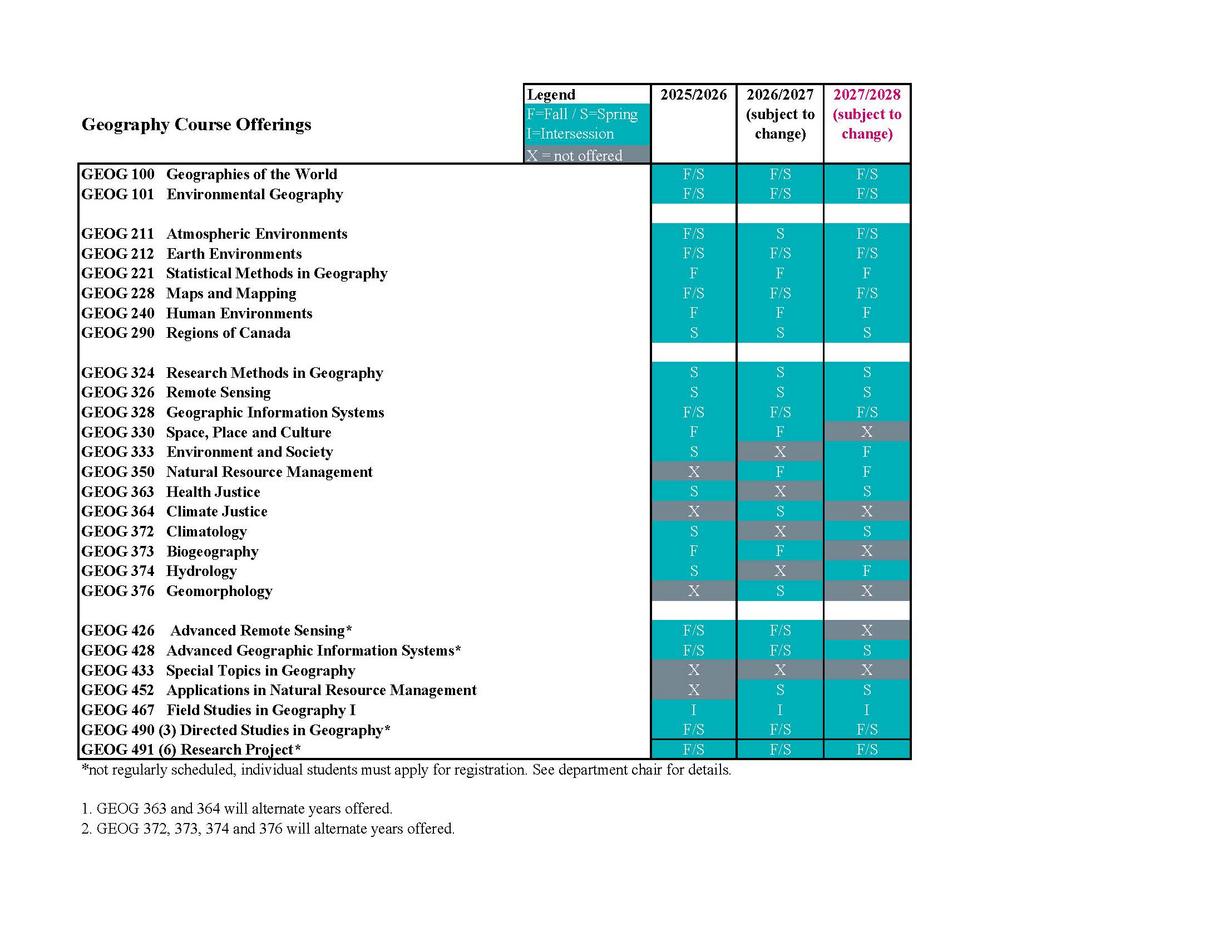
- Courses that are currently planned for Fall 2026 include: GEOG 100, GEOG 101, GEOG 212, GEOG 221, GEOG 228, GEOG 240, GEOG 328, GEOG 330, GEOG 350, and GEOG 373.
- Courses that are currently planned for Spring 2027 include: GEOG 100, GEOG 101, GEOG 211, GEOG 212, GEOG 228, GEOG 290, GEOG 324, GEOG 326, GEOG 328, GEOG 364, GEOG 376, GEOG 452, and GEOG 467.
The Geography Department has a directed studies policy that applies when a student requests a course from the Department as an individual directed study, or a faculty member proposes to offer a special course
(e.g. GEOG 465 Special Field Studies in Geography) for a small cohort of students (up to 5) that is not part of his or her regular workload assignment. This policy establishes that the decision to offer a directed study course lies with the Department, and not with individual instructors acting alone and without support from the Department. Directed studies courses are offered on a voluntary basis and are in addition to a faculty member’s regular workload.
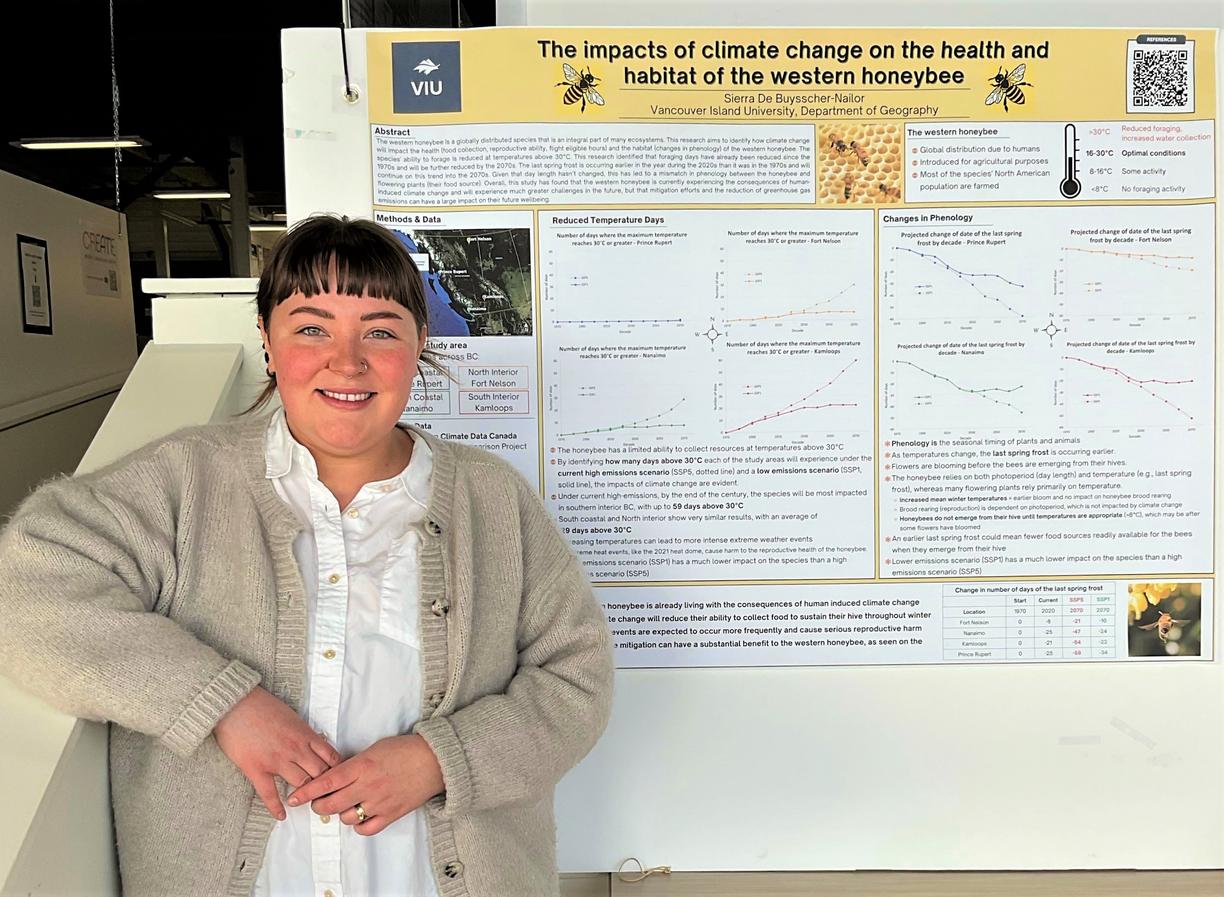
Sierra De Buysscher-Nailor at CREATE 2023
Application Procedure
To apply for a Directed Studies course, the student must fill out a request form and submit it to the Chair of the Department. For courses involving independent research (GEOG 490 or GEOG 491), students should make a request using the Geography Department Senior Research Project Request Form giving details about their proposed research project. For all other courses operating under the Directed Studies model, students complete and submit the Geography Department Directed Studies Request Form. A directed study request should be submitted no later than August 15th for a Fall semester course or December 1st for a Spring semester course; for year-long courses (e.g. GEOG 491), the request should be submitted no later than August 15th. Requests for directed study courses are discussed at a regular departmental meeting and voted on based on the criteria set out below. Forms can be obtained by contacting the Chair of the Geography Department (geochair@viu.ca).
Criteria
Decisions by the Department regarding directed studies requests are made in accordance with the following criteria. In all cases, an instructor must be found who is willing to supervise the directed study student.
- A student is about to graduate and is missing a specific required course that is not being offered in the current academic year. Note that course offerings are advertised for the current and immediately following academic years, so students should plan within that time frame accordingly.
- A student would like to undertake an independent research project, e.g. GEOG 490 or GEOG 491.
- An instructor(s) would like to offer a seminar course or a field studies course as a directed studies course. A decision to offer such a course will pay special attention to possible impacts on enrollment in other courses.
- A regularly scheduled upper-level course that is cancelled due to low enrollment may be offered as a directed study course; however, enrollment in other upper-level courses must not be significantly impacted by the offering of the directed study course.
- Directed studies courses should be assigned to faculty with relevant expertise, and distributed so that no faculty member has an unreasonable burden of directed studies courses.
GEOG 490 – Directed Studies / GEOG 491 - Research Project
Students enrolled in a BA in Geography or BSc in Geosciences are welcome to take either GEOG 490 – Directed Studies (3 credits) or GEOG 491 - Research Project (6 credits). If you are interested in independent research, you are encouraged to approach a Geography instructor and discuss your proposed research project. At least one instructor is required to supervise your research project. Prior to registering for this course, a written statement needs to be completed and submitted using the Geography Department Senior Research Project Request Form (GEOG 491) or the Geography Department Directed Studies Request Form (GEOG 490). This form is used to provide details about your proposed research project and should include a work schedule and a final date for completion of the project. This form must be signed by the instructor, and submitted to the Chair of the Department for approval. Students wishing to complete an honours Geography degree are required to complete a GEOG 491- Research Project.
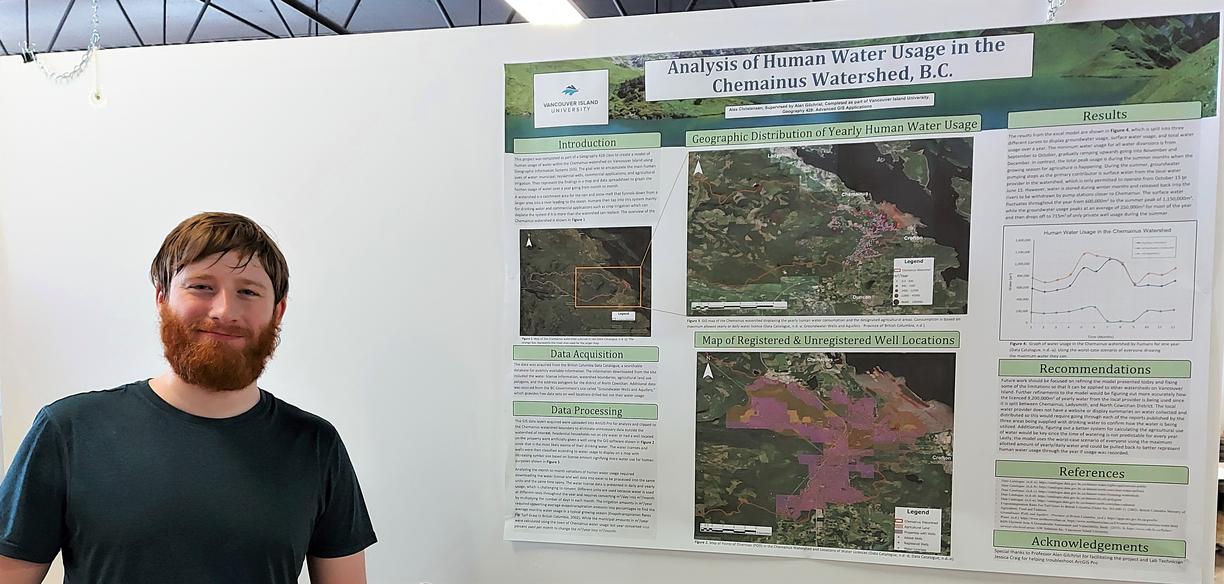
Alex Christensen at CREATE 2023
Research Ethics
A reminder that students who undertake individual directed studies or research projects that involve human subjects are required to have ethics approval from the VIU Research Ethics Board before beginning their projects.
Local and regional
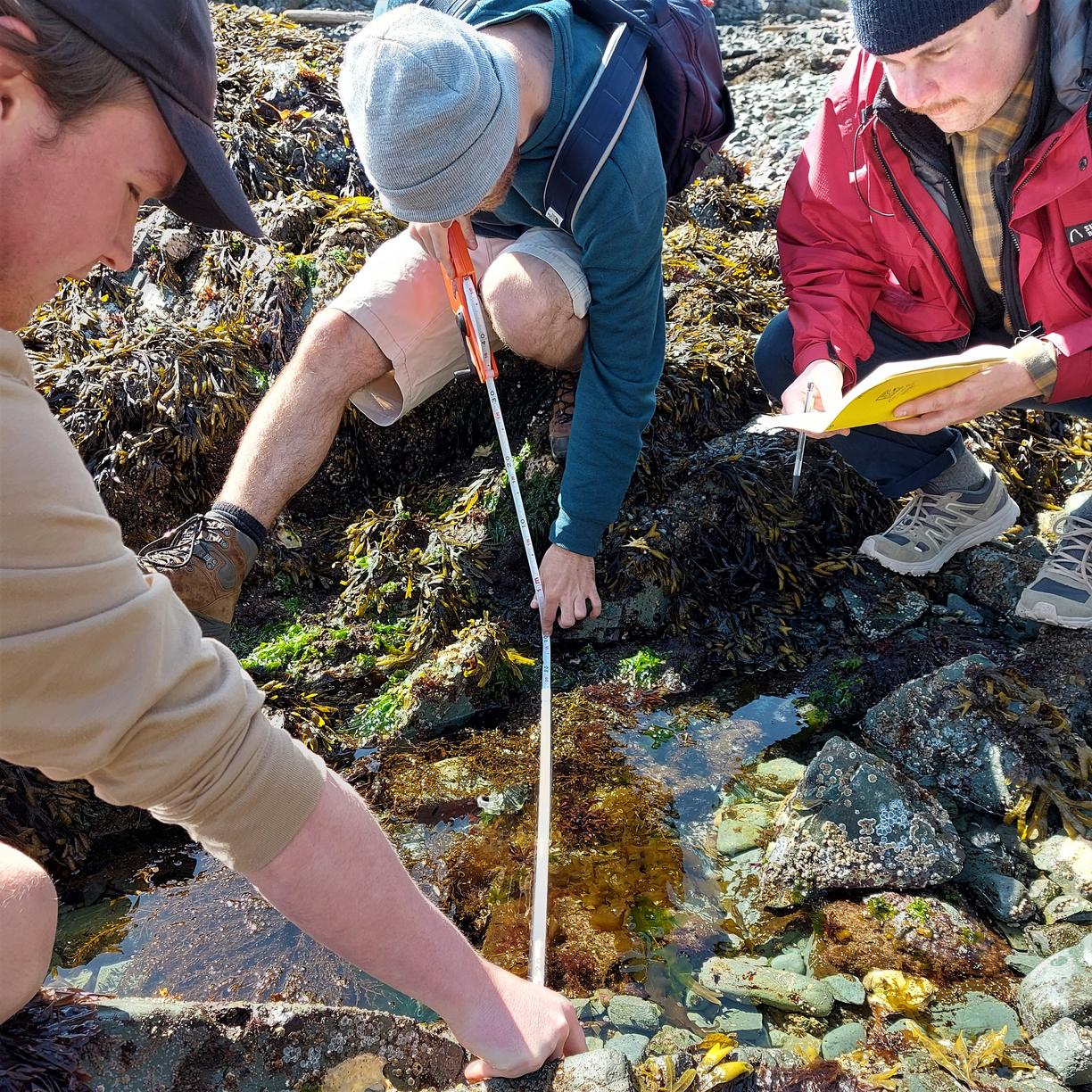
All students enrolled in the B.A. Major in Geography are required to complete GEOG 467 – Field Studies in Geography I. This course is delivered locally every spring. Students are encouraged to take this course at the end of their third year of studies so that they can apply the skills learned in their fourth-year courses.
GEOG 467 – Field Studies in Geography I is being offered at the Nanaimo campus. Students must register for GEOG 467 during the normal registration period for the academic year for the Spring semester. An initial orientation class will be held once early in the spring semester; the field-based course will be delivered immediately following final exams at the end of the Spring semester.
Note: This course is not part of Summer Session and will not conflict with regularly scheduled Spring semester courses.
National and international
In some years, students may have the option of taking a field course in another part of Canada or outside the country as part of a larger geography field school program. The field studies may be offered as a single course (GEOG 465 - Special Field Studies in Geography) or as multiple courses in the case of a field school. The field school is often a six or nine credit program consisting of GEOG 465 and one or two additional courses (e.g. GEOG 466 - Regional Studies; GEOG 433 - Special Topics in Geography). Students enrolled in a six-credit, or more, field school program are eligible for student loans.
The honours program
The main advantage of the Honours degree in Geography is that it will help students to see themselves as professionals in the discipline and so will better prepare them for graduate or professional programs. The research project provides an opportunity for putting the required communication, research and analysis courses into holistic practice; and is becoming a standard expectation for entrance into most graduate programs. VIU is already well established as an institution that provides a breadth of experience suitable for post-program success. The Honours program establishes these standards as a way to strengthen the transition to graduate and professional situations.
The Program Outline, Admissions and Deadlines
Students must complete the following two forms and submit them to the Geography Department Chair. Students may apply any time after completion of 45 credits and prior to March 31 in the year preceding their final year of study. Contact the Chair of the Department, GeoChair@viu.ca for copies of the forms, or for further information about Geography programs at VIU.
- Geography Honours Program Application Form (Due March 31)
- Senior Research Project Request Form (Due August 15 for Fall Semester)
Forestry transfer option
Forest Resources Technology Diploma and BA Major in Geography
Students undertaking the Geography BA degree will be challenged to think critically from a variety of perspectives, analyze problems and seek resolutions to natural resource conflicts. Students with the dual credential of a Forestry Diploma and a BA - Geography, will be eligible to register as an Allied Science Forester in Training (ASFIT) and work towards becoming a Registered Professional Forester (RPF) with the Association of BC Forest Professionals (ABCFP).
The BA Major in Geography offers an optional concentration in Environment, Society, and Sustainability attained by taking a certain selection of upper-level Geography electives.
Program requirements
Each candidate for a first Bachelor’s degree is required to meet the following broad conditions.
- Minimum 120 credits
- At least 6 of those 120 credits must be first-year ENGL or first-year LBST
- At least 42 of those 120 credits must be at 300-level or above
- Minimum 2.0 (“C”) GPA on all upper-level courses attempted or completed.
- Credits earned towards a FRST Diploma can be applied to the BA.
Graduates of the VIU Forestry Resources Technology Diploma transferring into the BA Geography Major program must first satisfy the requirements for the Forest Resource Technology Diploma in Years 1 and 2, and then continue on in Years 3 and 4 to satisfy the requirements for a BA degree in Geography.
Students coming into year 3 of the program will receive equivalency credit for FRST 121 in place of GEOG 228, MATH 181 in place of GEOG 221, FRST 328 in place of GEOG 328, and the DER can be met with ENGL 115 and ENGL 125 (or two of any other DER courses). All the other FRST courses count as electives toward the Geography BA.
Note #1: This information is provided for guidance only. Degree completion is based on courses completed successfully and is subject to all applicable requirements and procedures in effect. Students should consult with a BA Degree Advisor to confirm program requirements.
Note #2: An application to the BA Program is needed in order to move from the Forestry Diploma to the BA Major in Geography. View Admissions Tuition and Fees for further details.
For further details on transferring from the Forestry Resources Technology Diploma to the Geography BA program contact the Chair of the Geography Department, at GeoChair@viu.ca.
Specific course requirements for a BA in Geography:
Courses denoted with an asterisk (*) in the list below transfer equivalencies from FRST coursework, and are therefore not required to be taken by Forestry-Geography transfer students. All courses listed are 3-credit courses.
- 24 lower-level course credits
- GEOG 100 (3) – Geographies of the World
- GEOG 101 (3) – Environmental Geography
- GEOG 211 (3) – Atmospheric Environments
- GEOG 212 (3) – Earth Environments
- *GEOG 221 (3) – Statistical Methods in Geography
- *GEOG 228 (3) – Maps and Mapping
- GEOG 240 (3) – Human Environments
- GEOG 290 (3) - Regions of Canada
- 30 upper-level course credits
- GEOG 324 (3) – Research Methods in Geography
- *GEOG 328 (3) – GIS
- GEOG 467 (3) – Field Studies in Geography I
- Seven upper-level GEOG electives courses
- Interested students can complete a concentration within the BA in Environment, Society, and Sustainability by choosing four of the seven upper-level GEOG electives from:
- GEOG 330 (3) – Space, Place, and Culture OR GEOG 333 (3) – Environment and Space
- GEOG 350 (3) – Natural Resource Management
- GEOG 363 (3) – Health Justice OR GEOG 364 (3) - Climate Justice
- GEOG 452 (3) – Applications in Environment, Society, and Sustainability
- Other GEOG electives offered annually or bi-annually (~) include
- GEOG 320 (3) – Planning and Management of Parks and Protected areas
- GEOG 326 (3) – Remote Sensing
- ~GEOG 372 (3) – Climatology
- ~GEOG 373 (3) – Biogeography
- ~GEOG 374 (3) – Hydrology
- ~GEOG 376 (3) – Geomorphology
- ~GEOG 428 (3) – Advanced GIScience
- GEOG 490 (3) – Directed Studies in Geography
- GEOG 491 (6) – Research Project
Professional Accreditation
Note the VIU Forestry program is not an accredited degree. One option for gaining RPF designation is completing a BA Major in Geography coming in from the Forest Technology Program, and then going on to do a Masters at UBC. For full details on professional requirements go to Forest Professionals British Columbia.
Zack Masters
"After completing my Forestry Resources Technology diploma at VIU, I enrolled in the BA Geography program which allows me to apply to become a Professional Forester through the Allied Sciences Forester-in-Training program with the ABCFP.
This allows me to follow my desired career path as a Forester, combining my previous technical background and work experience in the forest industry with a larger grasp on a wider scale of natural resource management principles across other areas of study and industries.
Much like the Forestry Diploma program, the Geography faculty prioritises the success of the students. This ensures everybody is able to achieve their highest level of learning. I highly recommend the BA transfer program to anyone who wants to pursue a career in Forestry while staying local to Vancouver Island."
Marcus Tonon
"As a graduate of the Forest Resource Technology Diploma with the goal of obtaining a Registered Professional Forester (RPF) designation, bridging into a Geography degree was a very appealing path. The 2-year degree option allowed me to complete my education a year earlier than if I had chosen to pursue a Forestry Degree. In turn, I was able to enter the workforce in my field of study earlier, and gain an advantage on my peers who followed the traditional 3-year bridge program to UBC and UNBC. If you are considering this option, you will be required to obtain your RPF via the ASFIT route, so be aware of the additional requirements. "
Graham Sakaki
"After completing my Forestry diploma, I immediately transferred into third year of the Sustainable Resource Management stream in Geography at VIU. There is a seamless transition into the Geography program. The Geography route was great for me, and I highly recommend the transfer option.
While completing my BA, I was able to become more involved around Campus through volunteering, work-op and research assistant (RA) positions. These experiences enabled me to meet many people on campus and throughout the community which aided me in obtaining my current job."
Amanda Jefferies
"I decided to do the transfer program because I wanted to further my education and the Geography department allowed me to do so. I also knew that having a Bachelor’s degree would be an asset when starting a career.
This type of degree helps you learn and develop a wide range of skills that employers are looking for. A Geography degree is a broad based academic degree that will give you many options. My advice for you if you decided to go down this route, make sure you get involved with the Geography department and the Geographic Students’ Union. Your fellow geographers and professors are one of your biggest foundations for success."
Mike Anderson
"A bachelor’s degree in Geography is applicable to many professions from city planning to environmental protection. A degree in geography is also a path to becoming professionally certified in the forest industry – another reason that motivated me to enroll in the program.
I wanted to advance my understanding of natural resource management beyond the forest industry. The geography program interested me because of the variety of courses offered in the physical and social sciences. I would recommend the geography option to forestry students who are seeking a diverse degree option that offers a chance to learn about the world around us from multiple perspectives. Concepts and processes are emphasized in geography, which I think compliment the technical field skills learned in forestry well."